


Christmas market at Römerberg: How Frankfurt visualizes visitor numbers in real time
Data protection-compliant crowd management with LiDAR: How Frankfurt visualizes visitor numbers in real time

The challenge: Safe visitor traffic at large events
Large events such as Christmas markets, city festivals, or sporting events attract large crowds every year. For local authorities, this means that visitor numbers must be reliably recorded in order to better assess security situations, identify bottlenecks, and provide guidance to citizens. At the same time, requirements for data protection, cost-effectiveness, and technical connectivity are becoming more stringent.
Local authorities are faced with the question:
How can real-time monitoring of urban areas be achieved in compliance with data protection regulations without creating new hardware islands and, ideally, using existing infrastructure?
A current pilot project in the city of Frankfurt am Main provides a clear answer to this question.
The pilot project in Frankfurt: real-time crowd management, Christmas market at Römerberg
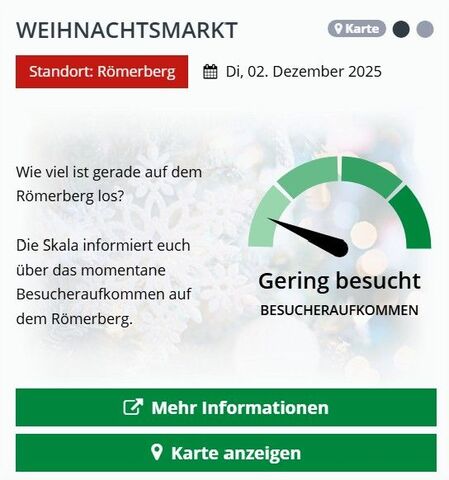 Together with ekom21 and Tourismus+Congress GmbH, [ui!] Urban Lighting Innovations is supporting the city of Frankfurt in anonymizing and displaying visitor numbers to the Christmas market at the Römer in real time.
To this end, several LiDAR sensors were installed in the vicinity of the market and embedded directly into existing municipal systems:
- Integration into the COCKPIT of ekom21
- Connection to the urban data platform of the city of Frankfurt am Main
Access to real-time data is publicly available: Frankfurt am Main Urban Data Platform
How LiDAR technology guarantees anonymity: From sensor to data platform
A central element of the project is strict compliance with data protection requirements. The chosen technology is ideal for recording movement patterns without processing personal data.
What makes LiDAR so special here:
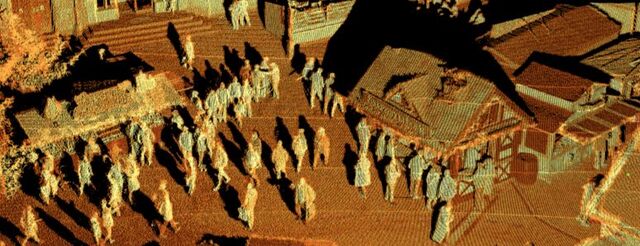
- LiDAR does not generate images, but rather anonymous 3D point clouds.
- No faces, physical characteristics, or individual data are stored.
- The system only recognizes movements and quantities, not individuals.
- Low-impact solution thanks to edge computing
The solution implemented by [ui!] Urban Lighting Innovations was deliberately developed to remain economically scalable and compatible with municipal networks:
- All raw data is processed directly in the device.
- Point clouds never leave the sensor.
- Only anonymized, aggregated count data is transmitted.
The system is: compliant with data protection regulations, energy-efficient, easy to integrate, cost-effective, and embedded in the urban data platform.

The urban data platform of the city of Frankfurt bundles sensor data from various sources and transmits visitor numbers in real time.
It serves as:
- a central overview of the situation
- a basis for planning
- a source of information for citizens
The project thus exemplifies how modern smart city architectures work when sensor technology can be connected without new isolated solutions.
Concrete added value for municipalities and citizens
The real-time data from the Frankfurt pilot project clearly shows how anonymized visitor frequency measurement can support various municipal areas.
For municipalities and event management
- Greater safety: Bottlenecks can be identified early on.
- Better planning: Visitor numbers can be estimated realistically.
- Evidence-based decisions: Data helps with planning routes, areas, and events.
- No additional infrastructure: LiDAR can be embedded in existing systems.
For citizens
- Better orientation: Visitors can avoid peak times.
- Greater convenience: Stays can be planned more easily.
- Transparent data: The city communicates openly and in compliance with data protection regulations.
Outlook: LiDAR on light poles from 2026
As an external specialist partner of ekom21, [ui!] is paving the way for LiDARKit, a solution planned for 2026 that will bring LiDAR to lampposts in a manner comparable to TrafficKit, scalable at the municipal level.
LiDAR has the potential to become an integral part of urban data infrastructure in the long term: flexible, GDPR-compliant, and economically viable.
Conclusion: [ui!] as a partner for modern urban solutions
The pilot project in Frankfurt exemplifies how municipalities can map visitor numbers in a data-efficient, anonymized, and real-time manner: without new hardware islands, with full GDPR compliance, and embedded as a tile in existing COCKPIT systems, the urban data platform.
As a specialist in smart urban solutions, [ui!] supports municipalities in the implementation of crowd management, urban data solutions, and scalable sensor technology, from the pilot phase to regular municipal operation.


